RETURN TO OFFICE
The workforce in downtown Minneapolis is currently reanimated to approximately 44.6% working in downtown offices. As COVID-19 cases stabilized after the Omicron wave, the return to office has ramped up in the spring of 2022. However, many workers may continue to have the option to work remotely or in a hybrid capacity indefinitely.
|
WHAT THE DATA IS TELLING US The mpls downtown council and partners began collecting return to office data in August 2020, when the share of employees working in-office in the core business district of downtown Minneapolis was estimated at 12.2%. The return to office remained roughly 15%-16% through the fall of 2020 and early months of 2021. Last spring, the share jumped significantly to 23.3%, the largest monthly increase and the largest share of in-office workers seen since the data was first collected, and has continued to increase since (other than a minor set back in January of 2022). This is a strong indication that there has indeed been a shift in working situations for thousands of downtown employees, though there is much to be determined as employers weigh decisions around health and safety, efficiency, costs, and employee preferences. The share of workers is calculated based on a total number of employees from when businesses were bringing the standard 100 percent of their employees into the office prior to the COVID-19 pandemic. |
POWERED IN
|

 |
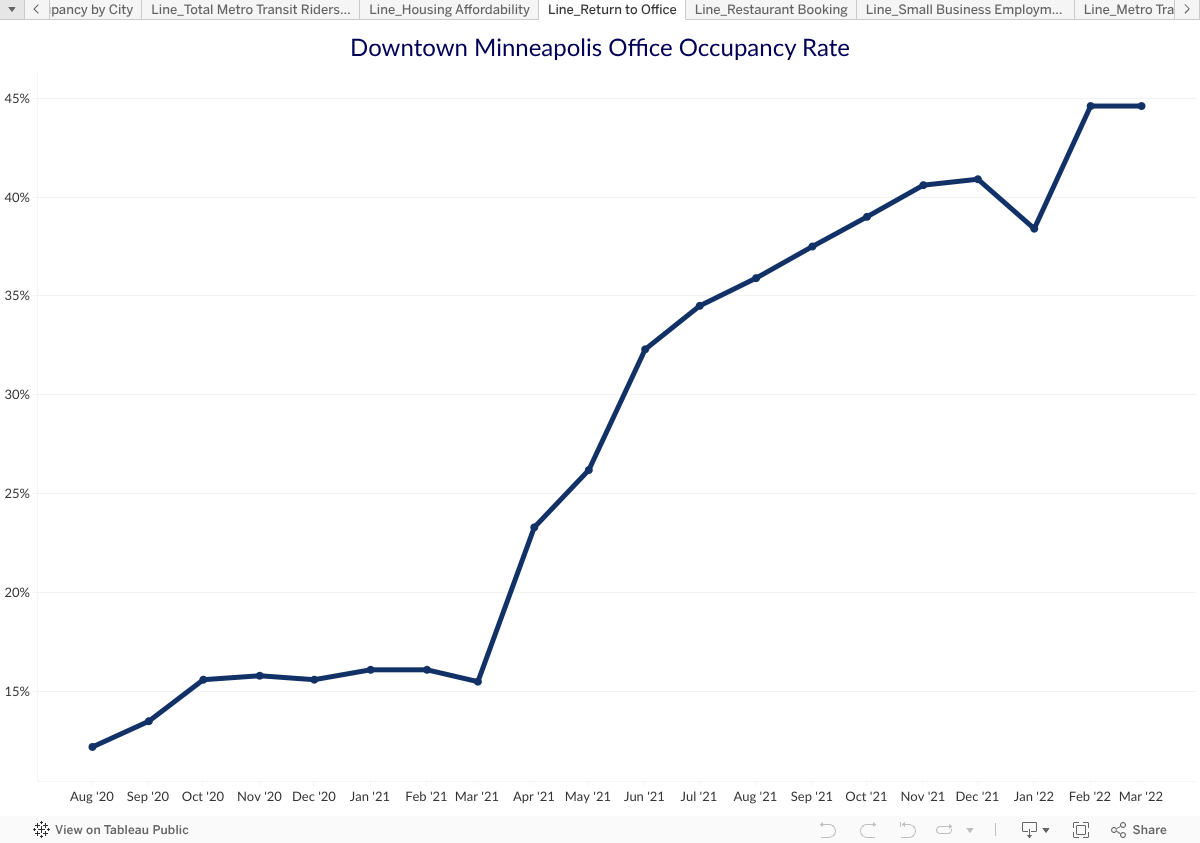 |
This metric tracks the share of employees working in person/in office in the core business district of downtown Minneapolis, according to a biweekly survey of select businesses.
WHY THIS MATTERS TO ECONOMIC RECOVERY:
The COVID 19 pandemic is reshaping work and the future of work as we know it. In March of 2020, a large majority of office workers switched to remote work, and many have remained in a work from home situation for more than a year and a half. This has impacted workers lives and businesses in so many ways, but core business districts like downtown Minneapolis and Saint Paul have seen a significant transition to remote work. As COVID19 cases continue to fluctuate in the region and state, it is expected that many major downtown employers may be slow to return to the office in order to keep employees safe. While return to office is important for downtown vibrancy, it is expected that returning to pre-COVID19 occupancy rates will take time, and office footprints will look different than what we remember. The near-term opportunity will be to continue to communicate with employers about ways they can be supported through this challenging time. Collectively, we have an opportunity across the region to discuss the future of office spaces and continued vibrancy of our downtowns.
RACIAL EQUITY AND INCLUSIVE RECOVERY:
The return to office is a measure that only reflects the experience of workers and businesses in downtown Minneapolis, as the data is only available for that geographic location currently. However, we know that this experience varies widely across geographic locations and across various demographic groups and income levels. Many jobs in industries like retail, food service, and healthcare are not able to be performed remotely, and these same industries employ a disproportionate number of BIPOC workers; an April analysis by GREATER MSP showed that 40% of BIPOC workers in the MSP region are employed in retail trade, accommodation/food service, and healthcare. These challenges faced by BIPOC workers amplify long-standing structural racial disparities in the MSP region.
TELLING THE FULL STORY:
With many employers having turned to long term or permanent remote working situations, many businesses have adapted to new ways of marketing and selling products, particularly in the industries and business locations that relied most heavily on the mobility and spending of daytime office workers. The return to office metric will not fully capture a return to pre-COVID consumer spending and consumer confidence, and it will not necessarily imply an uptick or return to pre-COVID productivity levels for workers and businesses that have been operating remotely. It will be important to continue watching other indicators of recovery to understand the full story, such as employment and unemployment figures, business closures, and the emergence of new and improved technologies to facilitate economic activity in a more remote future of work.
HOW TO LEARN MORE:
The mpls downtown council (mdc) is the business association helping downtown Minneapolis businesses, community leaders and citizens build on downtown assets and implement future goals. The mdc currently has over 450 member organizations ranging from Fortune 500s to start-up companies both downtown and throughout the Twin Cities. They collaborate with public, private and non-profit organizations to create a vibrant atmosphere in the city of Minneapolis’ core, advocate for initiatives that promote growth and stability, and forge a strong, inclusive 21st Century city.
GREATER MSP is watching trends in remote work closely and how it has been impacting businesses and workers in the region throughout the pandemic. The GREATER MSP blog showcases research from the GREATER MSP intelligence team on topics like impacts of remote work on women in leadership, talent and the future of the workplace, and 5 things that are changing right now in the future of work.
Want to share insights from the Regional Recovery Hub in your own presentations and materials? Download the Recovery Toolkit.